
- Muscular Endurance Training for Wrestling
- What Muscular Endurance Really Means in Wrestling
- Why Traditional “Conditioning” Fails Wrestlers
- How Muscular Endurance Should Be Trained in the Weight Room
- Method 1: Density Training
- Method 2: Cluster Sets
- Method 3: Timed Sets
- Method 4: Isometric Endurance
- Method 5: Wrestling-Specific Lifting Circuits
- How Often to Train Muscular Endurance
- How Muscular Endurance Fits With Wrestling Practice
- Signs Your Muscular Endurance Is Improving
- Common Muscular Endurance Mistakes
- How This Post Connects to the System
- Final Coach’s Take
Muscular Endurance Training for Wrestling
Strength That Lasts All Six (or Seven) Minutes
Written by our coaching and training crew
As far as athleticism goes, wrestling matches aren’t lost because someone isn’t strong.
They’re lost because someone can’t stay strong.
Most wrestlers feel this before they can explain it. The first period feels fine. The second is manageable. Then somewhere late—during a long scramble, a stubborn ride, or a grindy hand-fight—their strength just leaks out. Shots slow down. Ties feel heavier. Grip fades. Confidence drops.
That’s not simply conditioning problem.
That’s a muscular endurance problem.
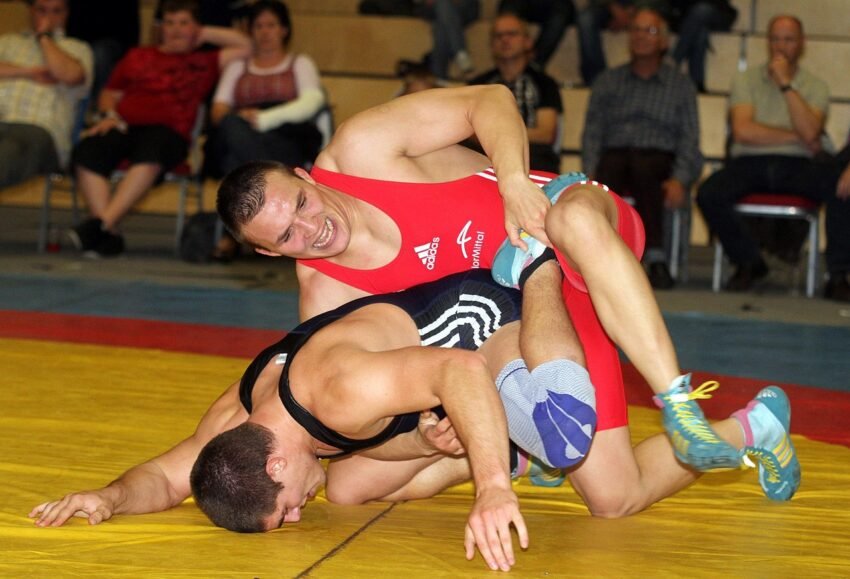
Muscular endurance in wrestling is the ability to repeatedly produce force under fatigue, from bad positions, while breathing hard and fighting resistance. It’s different from cardio. It’s different from bodybuilding endurance. And it’s one of the most misunderstood qualities in wrestling training.
This post breaks down:
- What muscular endurance actually means for wrestlers
- Why most “conditioning” programs miss the mark
- How to train endurance inside the weight room without sacrificing strength
This fits directly into the Weight Lifting for Wrestling system and builds on the exercise selection and lifting frequency foundations already covered.
What Muscular Endurance Really Means in Wrestling
Let’s clear up confusion right away.
Muscular endurance is NOT:
- Running long distances
- Random circuits done until you collapse
- “Just get tougher” conditioning
Those methods may improve breathing or mental toughness, but they often fail to preserve usable strength.
Muscular endurance IS:
- Repeated shots that still have pop
- Holding ties when your arms are on fire
- Staying solid in scrambles instead of collapsing
- Finishing takedowns late instead of stalling out
In wrestling, endurance is strength that doesn’t disappear when fatigue shows up.
Wrestling-Specific Definition
| Quality | Wrestling Example |
|---|---|
| Repeated force production | Multiple shot attempts |
| Isometric endurance | Riding, tough sprawls, not giving up ties |
| Local fatigue resistance | Grip, hips, upper back |
| Postural endurance | Staying in a good stance throughout the match |
If your strength vanishes after one hard exchange, muscular endurance is the missing link.
Why Traditional “Conditioning” Fails Wrestlers
A lot of wrestlers try to solve fatigue by piling on more conditioning. That usually helps heart rate recovery—but not strength expression.
Why Cardio Alone Isn’t Enough
| Method | What It Improves | What It Misses |
|---|---|---|
| Long runs | Aerobic base | Strength under fatigue |
| Bike intervals | Heart rate tolerance | Position control |
| Burpees | General work capacity | Sport specificity |
| Sprints only | Speed | Strength endurance |
To be clear, you still need conditioning. But conditioning without resistance does not teach your body to apply force when tired.
Wrestling fatigue isn’t just about breathing. It’s about local muscular fatigue—hips, upper back, forearms, and core failing under load.
That’s why muscular endurance must be trained with resistance.
How Muscular Endurance Should Be Trained in the Weight Room
The goal is simple:
Keep strength qualities present while fatigue rises.
That means training with:
- Moderate loads
- Short or controlled rest
- Structured density
- Intentional fatigue
Not chaos. Not random circuits. Not “just grind harder.”
Below are the most effective methods we have seen used on successful athletes.
Method 1: Density Training
Strength Repeated Over Time
Density training keeps reps consistent while time becomes the challenge.
Example Format
- 5 reps every minute on the minute
- Continue for 8–12 minutes
| Variable | Purpose |
|---|---|
| Fixed reps | Maintain strength quality |
| Short rest | Fatigue accumulation |
| Time constraint | Match-like stress |
Best Exercises for Density Work
| Exercise | Why It Works |
|---|---|
| Trap bar deadlift | Total-body force |
| Front squat | Posture + legs |
| Pull-ups | Grip & upper back |
| Push-ups or bench press | Upper-body endurance |
Key rule:
Use 1–2 lifts per session, not everything. Density training is powerful, but too much will eat into recovery.
Method 2: Cluster Sets
Strength Without Burnout
Cluster sets break a set into smaller chunks with short rest periods.
Example
- 4 reps
- Rest 15 seconds
- 4 reps
- Rest 15 seconds
- 4 reps
You still complete 12 reps, but fatigue is managed more intelligently.
Why Clusters Work for Wrestlers
| Benefit | Wrestling Transfer |
|---|---|
| High force output | Finishing late |
| Reduced form breakdown | Injury prevention |
| Better recovery | In-season friendly |
This method is excellent when you want endurance without frying your nervous system.
Method 3: Timed Sets
Work Capacity With Control
Timed sets shift the focus from rep counting to sustained effort.
Example Timed Block
| Exercise | Time | Goal |
|---|---|---|
| Goblet squat | 40 sec | Leg endurance |
| DB row | 30 sec | Upper-back stamina |
| Carry | 45 sec | Grip + core |
Best Exercises for Timed Sets
| Movement | Why It Works |
|---|---|
| Goblet squats | Safe under fatigue |
| Dumbbell rows | Postural endurance |
| Push-ups | Repeated pushing |
| Loaded carries | Match realism |
These sets should burn, but never turn sloppy. Once technique breaks down, the set is over.
Method 4: Isometric Endurance
The Most Overlooked Tool
Most wrestling positions are held, not always moved.
If you’re weak isometrically, you’ll feel strong early and helpless late.
Key Isometric Holds for Wrestling
| Isometric | Match Application |
|---|---|
| Wall sit | Shot defense |
| Split squat hold | Finish control |
| Plank hold | Ride stability |
| Grip holds | Hand fighting and top riding |
Programming Isometrics
| Duration | Goal |
|---|---|
| 20–30 sec | Strength bias |
| 30–45 sec | Endurance bias |
| 45–60 sec | Match simulation |
Isometrics work best:
- At the end of sessions
- Between main lift sets
- On lighter training days
They build endurance without joint wear.
Method 5: Wrestling-Specific Lifting Circuits
Circuits can be useful—but only when structured correctly.
Bad Circuits
- Random exercises
- No load control
- No rest standards
- No progression
Good Wrestling Circuits
- Compound movements
- Clear work/rest intervals
- Strength-based loading
Sample Wrestling Circuit
| Exercise | Time |
|---|---|
| Front squat | 30 sec |
| Pull-ups | 30 sec |
| Push-ups | 30 sec |
| Rest | 60 sec |
Repeat 3–4 rounds.
This works because:
- Loads stay meaningful
- Fatigue builds gradually
- Technique stays clean
How Often to Train Muscular Endurance
Muscular endurance does not need daily focus.
| Season | Frequency |
|---|---|
| Off-season | 1x/week |
| Preseason | 2-3x/week |
| In-season | 1x/week |
Too much endurance work leads to:
- Strength loss
- Flat matches
- Poor recovery
The goal is enough stimulus, not constant fatigue.
How Muscular Endurance Fits With Wrestling Practice
Practices already tax endurance. Lifting should support, not compete.
| Practice Intensity | Weight Room Adjustment |
|---|---|
| Hard live days | Short endurance work |
| Technical days | Slightly higher volume |
| Tournament week | Minimal |
| Multi-match week | Maintenance only |
If both lifting and practice feel crushing, one must change.
Signs Your Muscular Endurance Is Improving
| Sign | What It Means |
|---|---|
| Stronger late shots | Strength retention |
| Better tie control | Upper-back endurance |
| Less grip fade | Forearm capacity |
| Faster recovery | Improved work tolerance |
These matter far more than any conditioning test.
Common Muscular Endurance Mistakes
| Mistake | Why It Backfires |
|---|---|
| Endless circuits | Strength erosion |
| No load tracking | No progression |
| Conditioning every day | Overtraining |
| Ignoring isometrics | Weak positions |
Endurance must be trained deliberately, not guessed.
How This Post Connects to the System
This post answers how to keep strength present under fatigue.
It connects directly with:
- Exercise selection
- Lifting frequency
- Upcoming posts on explosive strength and grip endurance
Together, they form a complete wrestling-strength framework.
Final Coach’s Take
Muscular endurance isn’t about surviving exhaustion.
It’s about staying dangerous when everyone else fades.
Train strength first.
Then train it to last.
That’s wrestling endurance done right.
If you found this post to be helpful, then you may be interested in the rest of our blog page here.
Discover more from GearAffiliate
Subscribe to get the latest posts sent to your email.